

Why Does Elastic Lace Decide Whether My Garment Feels Premium?
2025-12-11
When I first switched from rigid trims to Elastic Lace, the difference in fit, recovery, and customer feedback was immediate. Working with L&B, I learned that not all elasticated lace is equal; yarn choice, knitting density, and finishing decide whether a bra wing stays supportive, whether a sports top keeps its shape, and whether a dress hem returns to form after a full day of movement. In this guide, I share the checkpoints I use when specifying Elastic Lace—from fiber blends to lab tests—so your next collection benefits from the right balance of stretch, hand feel, and durability. By the end, you’ll know how to brief suppliers and what proofs to request before you commit to Elastic Lace at scale.
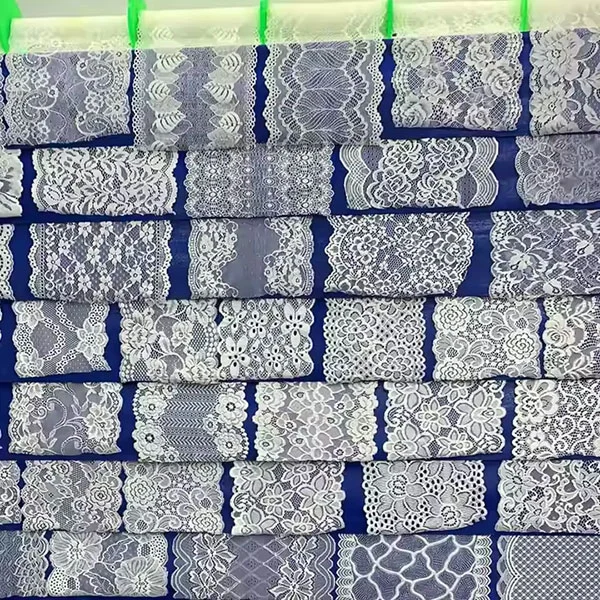
What Problems Does Elastic Lace Actually Solve?
I moved to Elastic Lace to fix three recurring issues in intimates and athleisure: inconsistent recovery, itchy edges, and warped hems after washing. Good elasticated lace addresses these pain points with controlled elongation and soft-touch finishing. Here’s how I frame it when auditing samples:
- Fit stability under real movement—no rolling, tunneling, or bagging around curves.
- Skin comfort for long wear—no scratchy bindings thanks to brushed or softening finishes.
- Wash resilience—shape and color hold after repeated domestic cycles.
- Production efficiency—predictable stretch along the course and wale for consistent sewing tension.
- Design freedom—openwork patterns that still deliver engineered support zones.
How Do I Choose The Right Fiber Blend?
In my specs, I separate “beauty fibers” from “function fibers.” Nylon or polyester define the look and drape, while spandex (elastane) controls the stretch. I ask L&B for blend options tuned to end use:
- Lingerie where softness is king—micro-nylon with moderate spandex for a silky hand.
- Daily shapewear—higher spandex content for stronger recovery and hold.
- Athleisure—filament polyester for colorfastness and sweat resistance with balanced stretch.
- Children’s wear—OEKO-TEX compliant inputs and gentle finishes for sensitive skin.
- Formalwear trims—sheer, stable grounds that won’t wave or flare after pressing.
Which Performance Numbers Should I Request From The Factory?
I keep a short checklist and ask for data sheets alongside hand swatches. This keeps the conversation factual and avoids surprises later in production:
- Elongation and recovery percentages in both directions at defined loads.
- Dimensional stability after specified wash and dry protocols.
- Colorfastness to washing, perspiration, and light based on target markets.
- Edge behavior when cut—fray propensity and laddering tendency.
- Finish chemistry documentation and compliance certificates where required.
Can I Compare Options Quickly Without Overwhelming My Team?
Yes—this single-page matrix helps me filter samples before I escalate to full prototype runs. It captures the essentials I expect from Elastic Lace lines targeted at different categories.
| Use Case | Typical Blend | Stretch & Recovery | Width Range | Edge Type | Finishing | MOQ & Lead Time |
|---|---|---|---|---|---|---|
| Lingerie wings / frames | Nylon 85% / Spandex 15% | Elongation 120–150%, recovery > 90% | 10–200 mm | Picot / scallop | Soft-hand, anti-pilling | 3,000 m, 10–15 days |
| Athleisure waist / cuffs | Polyester 80% / Spandex 20% | Elongation 100–130%, recovery > 92% | 15–220 mm | Flat stable edge | Moisture-manage, color lock | 3,000 m, 12–18 days |
| Shapewear panels | Nylon 70% / Spandex 30% | Elongation 80–110%, recovery > 94% | 20–240 mm | Engineered mesh | High-recovery set | 5,000 m, 15–20 days |
| Kidswear trims | Micro-nylon 88% / Spandex 12% | Elongation 110–140%, recovery > 90% | 8–150 mm | Rounded soft edge | Gentle finish, OEKO-TEX* | 3,000 m, 10–15 days |
*Compliance available on request for specific SKUs.
Why Do Pattern Engineering And Sewing Parameters Matter More Than I Thought?
Even premium Elastic Lace will underperform if the pattern and line settings fight the fabric. I keep these rules on every tech pack:
- Align high-stretch direction where comfort is needed; avoid accidental crosswise tension at sensitive zones.
- Set differential feed to prevent scallop distortion and tunneling along decorative edges.
- Test thread types and needle points to eliminate nicking on openwork motifs.
- Stabilize stress points with discreet tape without killing the aesthetic.
- Pilot wash prototypes before size grading to lock in real-world stretch maps.
How Do I Validate Quality Without A Full In-House Lab?
I run pragmatic, repeatable tests that mirror real usage rather than chasing exotic metrics:
- Five-cycle home wash test—measure width and pattern flatness before and after.
- Timed extension set—hold at target elongation for 30 minutes, then check recovery after 10 minutes rest.
- Edge abrasion swipe—simulate waistband rub to spot early fuzzing.
- Light sweat exposure—evaluate staining or dye crock on pale linings.
- Press test—confirm no glazing or deformation at your standard finishing temperature.
Where Does Design Meet Sourcing For Faster Launches?
With L&B, I build around carryover SKUs that the mill keeps in steady production, then layer seasonal colors once forecasts firm up. This lowers risk while keeping the look fresh. For unique motifs, I request strike-offs on the closest base from their Elastic Lace library and only then greenlight bulk. The speed gain from this approach is real, and it avoids re-learning shrink and stretch behaviors from scratch each season.
What Procurement Tips Help Me Avoid Costly Delays?
- Lock base color standards early and insist on lab dips under D65 and store lighting.
- Bundle widths where possible—one design, multiple widths—so production shares dye lots.
- Confirm spool and roll put-up that fits your machines to cut handling time.
- Pre-approve alternative yarns to safeguard supply without redoing the full test plan.
- Schedule golden size PP samples that stress the widest lace motifs first.
Could Elastic Lace Elevate My Brand Promise This Season?
If your returns cite fit fatigue, itchy trim, or post-wash warping, upgrading to a proven Elastic Lace program is one of the cleanest fixes I’ve made. With balanced blends, honest test data, and thoughtful sewing parameters, the same silhouette can feel bespoke. That is why I keep Elastic Lace as a core component in my briefs to suppliers and why I ask L&B to maintain continuity SKUs alongside new motifs each quarter.
Are You Ready To Specify Elastic Lace With Confidence?
If you want samples, data sheets, or a quick check on feasibility, I’m happy to share my shortlist and introduce you to the right team at L&B. Tell me about your end use, widths, target stretch, and compliance needs, and we can map suitable Elastic Lace lines within days. For pricing, lead times, or custom developments, contact us and include your projected volumes and color count so we can prioritize lab dips and ship swatches. Let’s make your trims work as hard as your designs—with the right Elastic Lace behind every piece.