What are the key manufacturing factors affecting the strength of high tenacity total bright nylon 66 filament yarn
2026-04-29
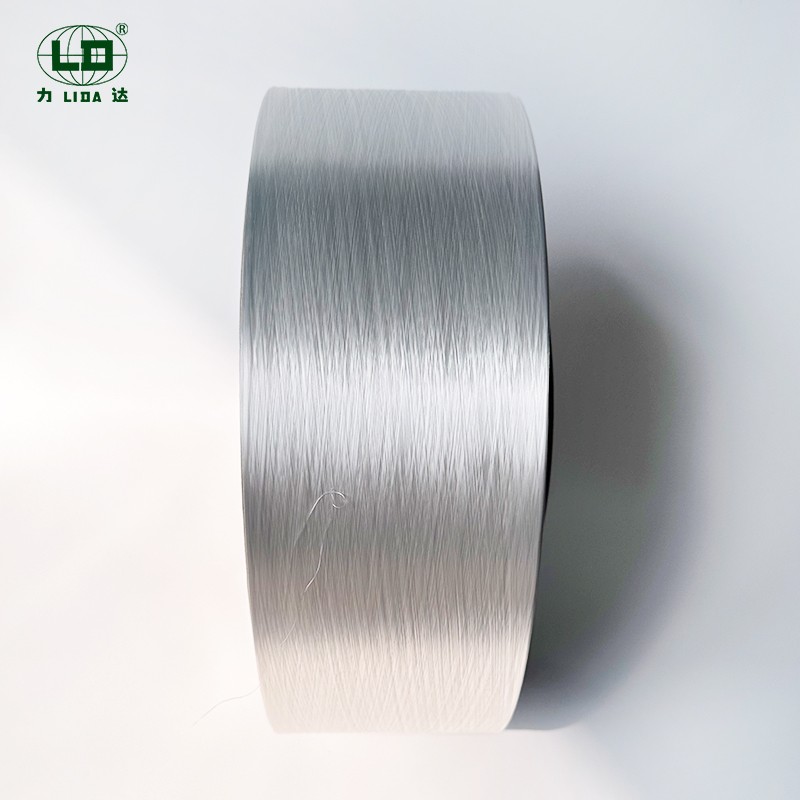
The production of High Tenacity Total Bright Nylon 66 Filament Yarn involves a precise interplay of chemistry, mechanics, and quality control. For manufacturers like LIDA, achieving optimal tensile strength requires mastering several critical processes. This article explores the key manufacturing factors that directly influence the strength of High Tenacity Total Bright Nylon 66 Filament Yarn, followed by frequently asked questions and expert insights.
Key Manufacturing Factors Affecting Tensile Strength
| Manufacturing Factor | Impact on Strength | Typical Control Method |
|---|---|---|
| Relative Viscosity (RV) of polymer | Higher RV increases molecular chain alignment and load-bearing capacity | Maintain RV between 3.4 and 3.8 |
| Spinning temperature | Excessive heat degrades polymer chains; too low causes incomplete orientation | Precision控制在 285–295°C |
| Draw ratio | Higher draw improves crystallinity and tenacity but risks filament breakage | Optimized ratio: 5.2–5.8:1 |
| Quenching air uniformity | Uneven cooling creates amorphous zones, reducing strength | Laminar airflow system with ±0.5°C consistency |
| Take-up speed | Affects pre-orientation; speeds over 3000 m/min increase tenacity | Closed-loop speed regulation |
Additional Critical Parameters
-
Spin finish application: Uniform lubricant coating reduces friction-induced damage during drawing and winding.
-
Humidity control: Excess moisture hydrolyzes nylon 66 at high temperatures, while low humidity increases static charges.
-
Winding tension: Excessive tension creates residual stress; insufficient leads to package collapse and yarn deformation.
Frequently Asked Questions (FAQ)
Q1: How does relative viscosity directly affect the tenacity of High Tenacity Total Bright Nylon 66 Filament Yarn?
A: Relative viscosity (RV) measures the average molecular weight of the nylon 66 polymer. Higher RV means longer molecular chains, which can be oriented more effectively during drawing. For High Tenacity Total Bright Nylon 66 Filament Yarn, an RV below 3.2 leads to chain slippage under load, reducing tenacity to under 7 g/den. Above 3.8, melt flow becomes difficult, causing filter pressure spikes and filament breakage. LIDA maintains RV between 3.4 and 3.7 to achieve a target tenacity of 8.5–9.5 g/den.
Q2: Why is quenching air uniformity critical for strength, and how is it measured?
A: After the polymer exits the spinneret, it must cool evenly to form consistent crystalline structures. Non-uniform quenching creates thick-and-thin sections: thick areas remain amorphous (weak points), while thin areas over-crystallize and become brittle. Uniform quenching ensures homogeneous molecular orientation. LIDA uses a radial laminar airflow system with temperature control (±0.5°C) and cross-sectional denier variation kept below 1.5% to guarantee yarn strength.
Q3: Can the draw ratio be increased indefinitely to improve tenacity?
A: No. While increasing the draw ratio aligns molecular chains along the fiber axis—boosting tenacity—exceeding the optimal range (typically 5.8:1 for High Tenacity Total Bright Nylon 66 Filament Yarn) causes chain scission, surface fibrillation, and a rapid drop in elongation-at-break below 12%. This makes the yarn brittle and unsuitable for weaving or knotting. LIDA conducts real-time draw tension monitoring to keep draw ratio within 5.2–5.6:1, balancing tenacity with elongation of 14–18%.
Why LIDA’s Process Delivers Consistent Strength
LIDA integrates real-time monitoring of viscosity, temperature, and draw tension into each production line. By controlling the five factors listed above, LIDA consistently produces High Tenacity Total Bright Nylon 66 Filament Yarn with >95% tenacity retention under standard industrial fatigue tests.
Contact Us
For technical specifications, sample testing, or bulk orders of High Tenacity Total Bright Nylon 66 Filament Yarn, please reach out to the LIDA team through our official website or email sales. Our engineers provide application-specific drawing recommendations and lot traceability reports. Contact us today to optimize your next high-performance textile project.