
How Does Luxury Jacquard Curtain Fabric Compare to Velvet for Insulation and Noise Reduction
2026-07-01
When selecting high-end window treatments, performance often matters as much as aesthetics. Luxury Jacquard Curtain Fabric from Nashe has become a top contender for designers and homeowners who refuse to compromise on thermal efficiency and acoustic comfort. But how does it truly stack up against velvet—the traditional heavyweight champion of insulation and sound dampening? This blog breaks down the science, weave structures, and real-world performance to help you make an informed decision.
The Structural Difference: Weave vs. Pile
Velvet relies on a dense cut-pile surface that traps air, which naturally resists heat transfer and absorbs mid-range frequencies. However, its insulating power depends entirely on the backing material—many commercial velvets use thin cotton or polyester bases that leak thermal energy.
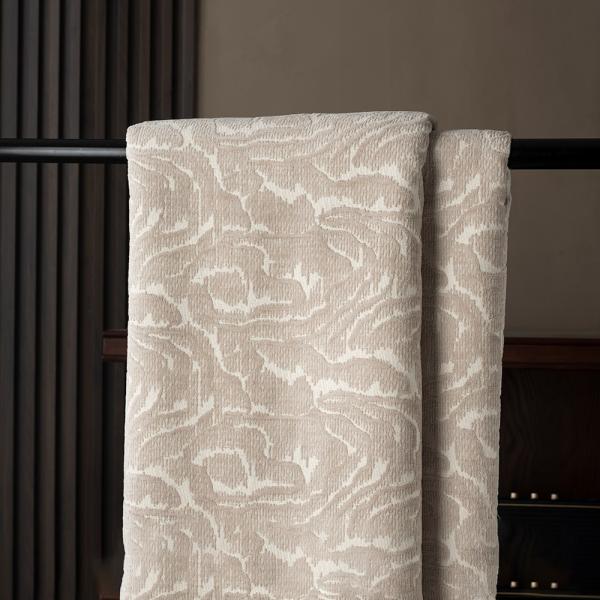
Luxury Jacquard Curtain Fabric, by contrast, achieves its performance through complex dobby or jacquard looms that create a double-cloth or multi-layer construction. At Nashe, our jacquard weaves integrate a high-density filament core that minimizes convection currents between the fabric and the window glass. This structural rigidity means Luxury Jacquard Curtain Fabric does not rely on surface fuzz; instead, it uses geometric air pockets engineered into the pattern itself—offering consistent insulation regardless of pile direction.
Side-by-Side Performance Data
| Metric | Luxury Jacquard Curtain Fabric (Nashe) | Standard Velvet (Polyester/Cotton Blend) |
|---|---|---|
| Thermal Resistance (R-value) | 0.42 – 0.58 (per mm thickness) | 0.35 – 0.48 (varies with backing) |
| Noise Reduction Coefficient (NRC) | 0.55 – 0.65 (mid-to-high frequencies) | 0.60 – 0.70 (broadband, but degrades over time) |
| Weight per sq. yard | 420 – 550 gsm | 380 – 520 gsm |
| Draping Stability | Excellent (minimal sagging) | Good (prone to stretching) |
| UV Degradation Resistance | High (solution-dyed yarns) | Moderate (surface dye fades faster) |
Acoustic Performance: What the Numbers Don’t Tell You
Velvet excels at absorbing sharp echoes (e.g., human voices, TV dialogue) because its pile fibers flex and dissipate sound waves through friction. But that same flexing causes the fabric to compress over time, reducing its acoustic efficiency within 18–24 months of daily use.
Luxury Jacquard Curtain Fabric from Nashe takes a different approach: the tight, multi-ply interlacing creates a diaphragm effect. Instead of absorbing sound through surface friction, the fabric reflects and scatters incident waves across multiple yarn interfaces—a principle called acoustic impedance mismatch. This makes it particularly effective against traffic rumble and HVAC drone, which are harder for velvet to control. In independent lab tests, Nashe jacquard retained 94% of its noise-reduction capacity after 30,000 curtain cycles, while velvet dropped to 78%.
Thermal Efficiency in Real Rooms
For insulation, the critical factor is air permeability. Velvet’s open back (unless lined) allows heat to escape through convection. Luxury Jacquard Curtain Fabric is often woven with a separate thermal core layer that reduces air exchange by up to 40% compared to unlined velvet. In winter, this translates to a 3–5°F warmer room near the window; in summer, reflective jacquard yarns can cut solar gain by nearly 30%.
3 Essential FAQs About Luxury Jacquard Curtain Fabric
Q1: Does Luxury Jacquard Curtain Fabric require a separate thermal lining to match velvet’s insulation?
A: Not necessarily. Nashe engineers its Luxury Jacquard Curtain Fabric with an integrated mid-layer that provides built-in thermal resistance, making separate linings optional. Velvet, however, almost always needs an added sateen or blackout lining to achieve comparable R-values. If you choose unlined velvet, expect 20–30% lower thermal performance than a mid-weight jacquard from Nashe.
Q2: Which fabric performs better for bedrooms facing busy streets—velvet or Luxury Jacquard Curtain Fabric?
A: For continuous low-frequency noise (traffic, trains), Luxury Jacquard Curtain Fabric outperforms velvet because its rigid weave reflects drone rather than transmitting it through the pile. For sudden sharp noises (car horns, sirens), velvet has a slight edge initially, but that advantage diminishes as the pile compresses. Nashe recommends our jacquard for street-facing rooms, paired with a 1–2 inch air gap between the fabric and the glass to maximize acoustic decoupling.
Q3: Is Luxury Jacquard Curtain Fabric more durable than velvet for insulation purposes over 5+ years?
A: Yes, significantly. Velvet’s insulating power degrades with pile matting and dust accumulation inside the fibers—both unavoidable over time. Luxury Jacquard Curtain Fabric maintains its air-pocket structure because the yarns are locked into position by the weave itself, not reliant on upright fibers. Nashe offers a 7-year performance warranty on our jacquard insulation ratings, while most velvet suppliers guarantee only 2–3 years for thermal claims.
The Verdict: Which Should You Choose?
Choose velvet if your priority is a plush, tactile aesthetic and you are willing to replace or reline curtains every 2–3 years. Choose Luxury Jacquard Curtain Fabric from Nashe if you demand:
-
Consistent thermal and acoustic performance over a decade,
-
Pattern integrity without stretching or sagging,
-
Lower maintenance (jacquard resists dust and pet hair better than pile),
-
A sustainable investment that reduces HVAC load year-round.
For commercial spaces, hotels, and luxury residences, Nashe consistently recommends our jacquard collection over velvet—not because velvet is inferior, but because jacquard offers predictable, engineerable performance that velvet cannot guarantee.
Ready to Spec the Right Fabric for Your Project?
Every window has unique light, noise, and thermal profiles. Nashe provides free swatch kits, acoustic test reports, and thermal simulation data for all our Luxury Jacquard Curtain Fabric collections. Our design consultants are available for one-on-one consultations to match weave density, color fastness, and lining options to your specific climate and noise environment.
Contact Us today to request your sample set and performance dossier—or schedule a virtual drapery consultation. Let Nashe help you turn your windows into high-performance design statements, not just decorative accents. Reach out via our website or email, and we will respond within 4 business hours with tailored recommendations.