
How Does Carding Cloth Enhance Fiber Processing Efficiency?
2025-12-12
Carding cloth plays a decisive role in modern fiber preparation, serving as the critical contact surface that opens, individualizes, and aligns fibers before they enter downstream manufacturing.
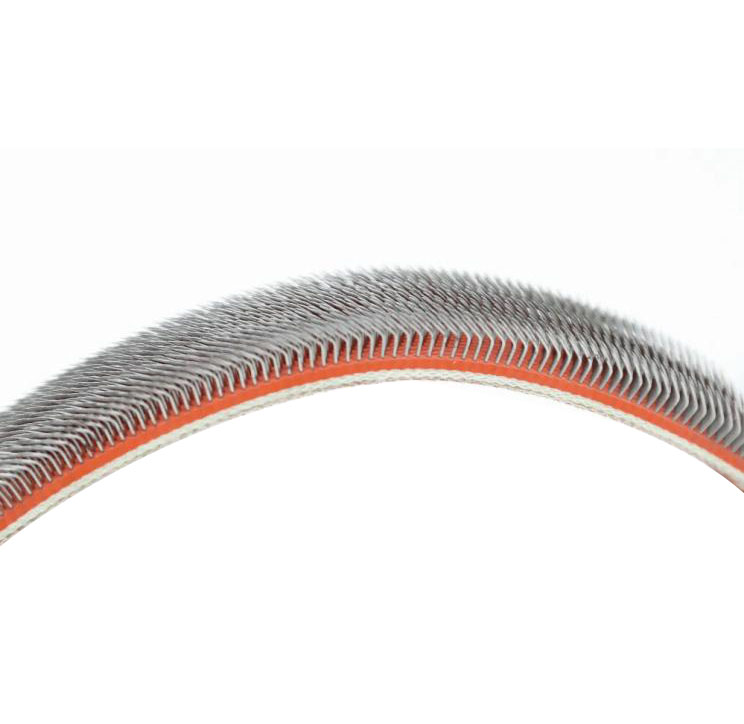
Carding cloth is engineered as a flexible, wear-resistant metallic or non-metallic wire matrix fixed on a backing foundation. It interfaces directly with raw fibers, using tooth profile geometry, density, and orientation to optimize fiber opening, parallelization, and removal of impurities. The focus of this article is to clarify how technical parameters—including tooth pitch, tooth height, wire hardness, foundation thickness, and cloth width—determine performance across different textile lines.
Below is a consolidated technical parameter table that reflects the specifications commonly referenced in industrial procurement and equipment matching:
| Parameter Category | Typical Specification Range | Functional Description |
|---|---|---|
| Wire Material | High-carbon steel / Alloy steel | Determines durability, heat resistance, and elasticity during high-speed carding |
| Tooth Height | 2.0–7.0 mm | Influences fiber penetration depth and opening aggressiveness |
| Tooth Pitch | 30–80 points per inch | Controls fiber density handling and precision of individualization |
| Tooth Angle | 45°–70° | Affects fiber transfer, trapping efficiency, and airflow behavior |
| Wire Hardness | 400–600 HV | Supports wear resistance during extended operation |
| Foundation Type | Elastic cloth / Hard cloth / Metal foundation | Ensures structural stability on cylinders, flats, or doffers |
| Cloth Width | 40–500 mm | Configurable for various carding machine brands and roller sizes |
| Backing Thickness | 0.8–2.5 mm | Contributes to mounting firmness and vibration absorption |
| Surface Coating | Anti-corrosion / Anti-static | Enhances lifespan and supports stable fiber behavior |
With this foundational understanding in place, the following four sections offer a detailed and technical narrative addressing operational function, industrial application, performance-driven advantages, and the evolving future of carding cloth manufacturing.
How Does Carding Cloth Optimize the Fiber Opening and Individualization Process?
Carding cloth achieves fiber opening through the controlled interaction between fiber bundles and tooth geometry. The distribution and inclination of the wire teeth determine how fibers are caught, separated, and later released. An optimized tooth profile minimizes fiber damage, ensures consistent transfer, and maintains a stable airflow layer, which is essential for high-speed carding machines.
In large-scale production lines, the ability of carding cloth to align disparate fibers influences the uniformity of sliver and the downstream quality of spinning or nonwoven formation. Variations in tooth hardness or pitch directly affect processing of different fiber types—cotton, synthetic, regenerated fibers, and blends—with each requiring tailored aggressiveness and retention force.
A well-engineered carding cloth also stabilizes machine behavior by reducing load fluctuation, allowing operators to run equipment at higher speeds with lower energy consumption. This optimization contributes to improved throughput and reduced production downtime due to wear or misalignment.
How to Select the Right Carding Cloth for Diverse Industrial Fiber Applications?
Selecting appropriate carding cloth requires evaluating fiber characteristics, machine specifications, and operational volume. Long-staple fibers demand greater tooth height and stronger penetration capability, while shorter or delicate fibers rely on a higher tooth density and smoother wire surface to minimize breakage.
For cotton lines, the emphasis is often on uniform opening and trash removal. In contrast, synthetic fibers require anti-static coatings and fine-tuned tooth geometry to handle higher friction and temperature sensitivity. Nonwoven production—particularly meltblown and spunlace processes—often uses customized cloth widths and foundation configurations to match unique line architectures.
Industrial buyers typically assess compatibility metrics such as wire hardness tolerance relative to cylinder rotation speed, mounting precision based on foundation thickness, and airflow management performance. The correct matching of these variables not only improves fiber output quality but also prolongs equipment service life.
To streamline decision-making, many factories maintain parameter mapping charts correlating fiber types with recommended tooth pitch, hardness, and angle, ensuring consistent performance across different production batches.
How Will Future Innovations in Carding Cloth Technology Transform High-Speed Fiber Processing?
The future of carding cloth lies in precision engineering, new-generation materials, and digital monitoring integration. Advanced alloy wires with higher fatigue resistance and refined surface treatment technologies are expected to reduce micro-wear, allowing for longer operation cycles without compromising quality.
One emerging direction is the development of nano-coated wire surfaces designed to reduce friction and improve fiber flow stability. These micro-structured coatings enhance resistance to corrosion, heat, and chemical exposure—attributes particularly valuable in synthetic fiber processing.
Meanwhile, advances in backing technology are enabling more precise vibration absorption and mounting stability, supporting the global shift toward ever-higher carding speeds. Machine-learning-driven quality monitoring systems are beginning to correlate sliver uniformity metrics with carding cloth wear patterns, allowing predictive maintenance that significantly reduces downtime.
Sustainability is influencing design as well. Manufacturers are adopting recyclable backing materials and energy-efficient production methods, providing more environmentally responsible options without reducing performance.
These innovations collectively point toward a future where carding cloth delivers higher efficiency, longer lifespan, and greater adaptability across a diverse range of fiber processing environments.
How to Troubleshoot Carding Cloth Performance Issues in High-Demand Production Lines?
Performance troubleshooting requires assessing mechanical conditions, fiber behavior, and wear patterns on the cloth surface. Excessive fiber breakage often indicates an overly aggressive tooth angle or improper foundation tensioning. Uneven sliver formation may arise from inconsistent cylinder alignment or wire densification due to prolonged operation.
Operators typically begin diagnostics by evaluating friction points, checking for contamination buildup, and measuring tooth deformation. Using calibrated gauges, technicians verify tooth pitch consistency and backing thickness to determine whether regrinding or replacement is required. In high-humidity production environments, anti-static coatings and controlled airflow adjustments can significantly mitigate fiber entanglement or inconsistent feeding.
Routine cleaning cycles are essential. Dust accumulation on the wire surface disrupts optimal fiber-to-tooth interaction, reducing output quality and increasing machine load. Manufacturers recommend scheduled inspection intervals matched to operating hours, fiber type, and machine speed.
Below are two common questions that arise during troubleshooting and daily operation:
Q1: Why does fiber entanglement occur on carding cloth during high-speed operation?
A1: Entanglement typically results from a mismatch between fiber length and tooth pitch, excessive humidity affecting fiber cohesion, or wear-induced tooth deformation. Ensuring proper tooth geometry, maintaining controlled environmental conditions, and conducting regular inspections help eliminate this issue.
Q2: How often should carding cloth be replaced to maintain stable production quality?
A2: Replacement frequency depends on fiber type, machine speed, and daily operational time. In most industrial settings, inspections at defined hourly intervals provide early detection of wear. Once wire hardness drops or tooth deformation reaches critical thresholds, immediate replacement is recommended to avoid sliver quality fluctuations and machine downtime.
Carding cloth is indispensable to high-precision fiber processing, directly influencing the effectiveness of fiber opening, alignment, impurity removal, and sliver uniformity. Its technical attributes—ranging from wire hardness and tooth geometry to backing structure—play a defining role in overall production efficiency. Industry trends indicate continued improvements in materials, coatings, and predictive operation technologies, ensuring more stable and sustainable textile manufacturing in the years ahead.
For industrial procurement teams seeking consistently reliable carding cloth with strong engineering support, Changzhou Ceres Machinery Co., Ltd. provides comprehensive product configurations and manufacturing expertise. To obtain detailed specifications or request tailored solutions for your production line, contact us for further consultation.