Custom High Tenacity Polyester Filament Yarn: Unraveling Its Strength, Versatility, and Industrial Applications
2026-07-02
In the world of industrial textiles, not all yarns are created equal. When applications demand exceptional strength, durability, and adaptability, custom high tenacity polyester filament yarn emerges as the backbone of innovation. At the forefront of this specialized field, Changshu Polyester has been quietly redefining what’s possible—from heavy-duty lifting slings to precision-engineered geotextiles. But what exactly gives this material its remarkable edge, and why are more industries turning to bespoke solutions? In this post, we’ll pull back the layers on the science, the versatility, and the real-world applications that make custom high tenacity polyester filament yarn a true powerhouse.
What Gives This Yarn Its Muscle?
The secret lies in the tight twist of the fibers and the high-quality materials. Unlike softer, fluffier yarns, this one has a dense construction that resists stretching and pilling, giving projects a defined structure that holds up wash after wash. The twist isn’t just about durability—it also brings out subtle texture variations in stitchwork, making cables and ribbing pop.
Blended with a touch of nylon or polyamide, the yarn gains extra reinforcement without losing its natural feel. That added resilience means your finished pieces can handle real-life wear, from slouchy bags that see daily use to cozy throws that get tossed around the living room. It’s the kind of strength that lets you design with confidence, knowing your work will keep its shape and character.
Customization: Not Just a Buzzword, a Necessity
In an era flooded with generic solutions and one-size-fits-all promises, standing still means blending in—and that’s a death sentence for relevance. Customization has evolved from a trendy add-on to the backbone of meaningful interaction. Whether it’s a tailored onboarding sequence or a product interface that adapts to user behavior, the expectation has shifted: people don’t just appreciate personalization; they demand it. The brands that thrive are those that treat every touchpoint as an opportunity to reflect an individual’s preferences, history, and needs, turning a simple transaction into a relationship.
What often gets overlooked is that true customization isn’t about swapping logos or inserting a first name in an email. It’s about understanding context deeply enough to anticipate what someone needs before they articulate it. This means moving beyond surface-level data and tapping into behavioral patterns, environmental cues, and real-time intent. When done right, it doesn’t feel intrusive—it feels intuitive. The line between “cool” and “creepy” is thin, and it’s walked by those who prioritize value over just visibility. The tools are there; the willingness to use them thoughtfully is what separates the leaders from the laggards.
The urgency for genuine customization is growing, not just because competitors are doing it, but because the cost of ignoring it is steep. In a landscape where loyalty is fleeting, a generic experience is an instant cue to move on. Customization isn’t a luxury—it’s the basic infrastructure for trust and retention. The companies that recognize this aren’t just keeping up; they’re rewriting the rules, proving that when you build for the individual, you earn the right to stay in the room.
Where the Rubber Meets the Rope: Industrial Roles
The fusion of rubber and rope creates a dynamic frontier across heavy industries, where tensile strength must meet elasticity under punishing conditions. From marine mooring lines that absorb shock loads to conveyor belt tension members that endure constant flexing, these hybrid assemblies demand precisely engineered interfaces. The industrial roles that emerge here are specialized and unforgiving—technicians and designers work at the literal junction where polymer science collides with fiber mechanics, often in environments where a failed splice or delamination isn't just costly, but catastrophic.
On drilling rigs and construction sites, the people who manage this rubber-to-rope interface operate as silent arbiters of safety and efficiency. They read the subtle degradation patterns in a hose's outer cover, predict when a steel cable's rubber jacket will crack, and understand the molecular marriage between vulcanized compounds and aramid braids. Their expertise expands into load distribution, chemical resistance, and dynamic fatigue—factors that machines alone can't fully interpret. It’s a hands-on discipline where the tactile feedback from a worn grip or a slightly stiffened segment often informs decisions that keep massive loads under human control.
These roles are evolving as advanced elastomers and high-modulus synthetics enter the mix, but the core responsibility remains rooted in the physical world. Remote monitoring and smart materials are reshaping the craft, yet true proficiency still hinges on an almost intuitive feel for how rubber deforms around a rope's twist, or how a coupling transmits force through a bonded layer. In an age of automation, this niche remains stubbornly analog at its heart—a specialized trade that thrives where the rubber literally meets the rope.
Toughness Beyond the Tensile Test
Toughness is often reduced to a single number from a tensile test—the area under the stress-strain curve. But in real-world applications, materials face far more complex scenarios: dynamic impacts, cyclic loading, cracks, and aggressive environments. A metal that stretches impressively in a slow pull might shatter under a sudden blow. This discrepancy reveals that true toughness is a multidimensional property, not a static metric. It’s about how a material absorbs energy and resists fracture across different strain rates, temperatures, and stress states. The uniaxial tensile test, while useful, only captures a narrow slice of performance. To understand toughness beyond the lab, we must consider fracture mechanics, impact testing, and the microstructure’s role in hindering crack propagation.
Fracture toughness, measured by parameters like KIC or J-integral, quantifies a material’s ability to resist crack growth. Unlike tensile toughness, it accounts for pre-existing flaws—a reality in any engineered component. A steel with high tensile ductility might fail catastrophically at low loads if its fracture toughness is poor, especially at low temperatures or in thick sections where plane-strain conditions dominate. Charpy and Izod impact tests add another layer, revealing the ductile-to-brittle transition behavior that tensile data alone cannot predict. Modern approaches, such as master curve analysis and dynamic tensile testing, bridge the gap between slow-strain lab benchmarks and the high-rate loading seen in crashes or blasts.
Beyond mechanical tests, toughness is profoundly influenced by microstructure: grain size, phase distribution, and inclusion content. Fine-grained alloys often outperform coarse ones by forcing cracks to follow tortuous paths. Transformation-induced plasticity (TRIP) and twinning-induced plasticity (TWIP) steels exemplify how clever metallurgy can amplify energy absorption without sacrificing strength. Even processing history—welding, forming, heat treatment—can create residual stresses that alter toughness in service. Ultimately, designing safe, durable components means going beyond the tensile test. It demands a holistic view where toughness is tailored to the specific demands of the application, accounting for real-world loading spectra and environmental threats.
The Making: Precision You Can’t See but Can Trust
Behind every product lies a realm of craftsmanship that escapes the naked eye. It's the micro-tolerances, the sub-millimetre adjustments, and the meticulous calibration that operate silently beneath the surface. These invisible standards don't announce themselves, yet they define the boundary between something that merely works and something that endures. Trust is built not on what you see, but on what performs consistently, year after year.
The journey of precision begins long before assembly. In temperature-controlled rooms, components are measured with light waves and laser interferometry—tools that detect deviations smaller than a fraction of a hair's breadth. Each part undergoes a dialogue with these instruments, refusing to pass unless it meets a threshold that seems almost obsessive. This is not about chasing perfection for its own sake; it's about eliminating the tiny variables that can, over time, compromise reliability. When a mechanism glides without friction or locks with an assuring click, you're experiencing the culmination of countless rejections and refinements invisible to you.
True precision reveals itself in quiet moments: in the smooth rotation of a dial, the seamless fit of a join, the absence of vibration where you'd expect it. These sensations are the language of trust, spoken without words. They are the result of an ethos that values integrity over shortcuts, where every hidden decision reflects a promise kept. You may never see the layers of scrutiny behind a finished piece, but you'll feel them in the sureness of its function, a quiet testimony to the art of the unseen.
Tomorrow’s Threads: Evolving with the Times
Fashion isn’t just about what looks good today—it’s a living record of where we’ve been and where we’re headed. Tomorrow’s threads are woven from the realities of a changing world: shifting materials, smarter design, and a collective push toward clothing that does more than just cover us. It’s an evolution, not a revolution, where each season’s choices quietly redefine what it means to get dressed.
Consider how the definition of durability has changed. It’s no longer just about a fabric lasting through years of wear, but about the entire lifecycle of a garment. Designers are tapping into regenerative materials, circular production models, and modular construction that lets pieces adapt to different needs. A jacket isn’t just a jacket anymore—it might be reversible, repairable, or made from fibers that breathe with your body. These aren’t gimmicks; they’re responses to a zeitgeist that demands more sensibility from style.
And then there’s the subtle shift in how we relate to our wardrobes. As digital lives bleed into physical ones, the idea of a garment telling a story becomes almost literal. Embedded NFC tags, QR codes linking to a garment’s origins, or even digital twins that live in virtual spaces—these are the quiet threads of a future where what we wear carries meaning beyond the moment. It’s less about trend cycles and more about choosing pieces that grow with us, blurring the line between fashion and personal narrative.
FAQ
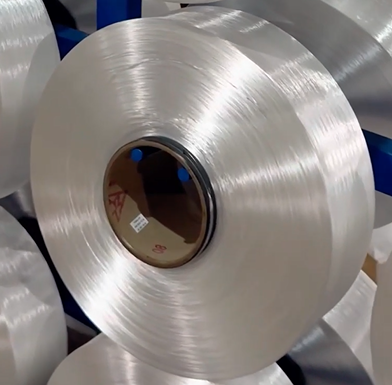
It’s a type of synthetic yarn made from polyester polymers that has been engineered to have exceptional tensile strength. The 'filament' part means it’s composed of continuous strands rather than short staple fibers, which gives it a smoother surface and consistent performance. High tenacity refers to its ability to withstand high stress without breaking, far exceeding regular polyester yarn.
Customization allows manufacturers to tweak the yarn’s properties during production. You can adjust the filament count, twist level, coating, or even add UV inhibitors and flame retardants. Standard yarns come with fixed specs, but custom orders let you match the exact needs of a project—whether that’s extra abrasion resistance for industrial webbing or a specific dye uptake for outdoor gear.
Its strength comes from the molecular alignment of the polyester chains during spinning and drawing. The polymer is stretched to orient the molecules in parallel, which maximizes intermolecular forces. This process, combined with the inherent toughness of polyester, gives it a specific strength that rivals many metals on a weight-for-weight basis while remaining flexible.
You’ll see it across a wide range: automotive seat belts and airbags, marine ropes and sails, geotextiles for soil reinforcement, safety harnesses, lifting slings, and even in sports equipment like tennis strings. It’s also big in the production of coated fabrics for tents and tarpaulins, where both tear resistance and weather resilience are critical.
It reduces material usage because you can use thinner yarns to achieve the same load capacity, which cuts weight and cost. It also improves product lifespan under harsh conditions—less frequent replacement means better value. For assembly lines, its consistency reduces machine stoppages, and the high elongation at break provides a safety buffer before failure, unlike brittle alternatives.
Apart from obvious heavy-duty uses, it’s found in medical devices like surgical sutures that need consistent tensile strength, in lightweight conductive yarns for smart textiles when coated with silver, and in craft industries where durability meets fine detail, such as high-end bookbinding threads. Some artisans even use it for making durable jewelry cords.
The process starts with selecting the base resin and then modulating the spinning parameters—draw ratio, quenching conditions, and finish application. Additives like carbon black for UV resistance or phosphorus-based compounds for flame retardancy are mixed into the polymer melt. Post-treatment coatings can further enhance properties like adhesion to rubber or water repellency. Each parameter can be fine-tuned for a given balance of strength, flexibility, and surface characteristics.
Conclusion
At its core, custom high tenacity polyester filament yarn is an engineered solution for demanding environments. Unlike standard polyester, its strength comes from a unique molecular alignment achieved during spinning and drawing, boosting tensile durability without adding bulk. This muscle isn't accidental—it's the result of precision-controlled viscosity, cooling rates, and draw ratios that tailor the yarn's elongation, shrinkage, and modulus to exacting specifications. Customization here is not a luxury; it's a necessity when off-the-shelf fibers would fail under dynamic loads, abrasion, or chemical exposure. From subtle tweaks in denier and filament count to advanced surface treatments that enhance adhesion to rubber or PVC, every parameter serves an industrial purpose, making the yarn truly application-specific.
In the field, this yarn proves its worth far beyond the tensile test. It's the backbone of high-strength ropes, slings, geo-textiles, and conveyor belts where steady force resistance outranks peak breaking strength. What sets it apart is a blend of UV stability, low creep, and fatigue resistance that keeps it reliable season after season. The manufacturing itself demands a level of consistency invisible to the eye but critical in use—temperature calibrated within fractions of a degree, winding tensions checked continually—so every meter performs identically. And as industries evolve, so does the yarn: today's versions integrate recycled content, lighter constructions, or smart coatings, evolving quietly alongside the machines and infrastructure that depend on them.
Contact Us
Contact Person: CONNIE
Email: [email protected]
Tel/WhatsApp: 86-0512-53671634
Website: https://www.lida-yarn.com/